Tuning-specific arpeggio diagram
Eb Dominant 7 Sharp 9 Arpeggio in E Flat Standard Tuning
Eb Dominant 7 Sharp 9 Arpeggio in E Flat Standard Tuning shows the same eb dominant 7 sharp 9 arpeggio chord tones across 6 strings tuned Eb Ab Db Gb Bb Eb. The tuning changes where the same chord tones sit across the fretboard.
- Chord tones
- Eb, G, Bb, Db, F#
- Formula
- 1 3 5 b7 #9
- Semitones
- 0 4 7 10 15
- Chord symbols
- Eb7#9
- Tuning
- Eb Ab Db Gb Bb Eb
- Strings
- 6
- Open pitch range
- Eb2 to Eb4
- 24-fret range
- Eb2 to Eb6
Open strings and root positions
5 of the 6 open strings belong to Eb Dominant 7 Sharp 9 Arpeggio: string 6 Eb (1), string 4 Db (b7), string 3 F# (#9), string 2 Bb (5), and string 1 Eb (1). Eb roots occur on open strings 6 and 1.
First root on each string
Low-string pattern
On the lowest Eb string, the first-octave arpeggio pattern falls at frets 0, 3, 4, 7, and 10, with the Eb root at fret 0. On the highest Eb string, the first Eb is at fret 0.
Practice this tuning-specific layout
- Play Eb Dominant 7 Sharp 9 Arpeggio on the low Eb string at frets 0, 3, 4, 7, and 10, saying each note name and degree aloud.
- Build a phrase that lets Eb on open string 6 ring, then connect it to the nearest Eb root and two other arpeggio tones.
- Connect the Eb root positions on strings 6 through 1 at frets 0, 7, 2, 9, 5, and 0, adding the nearest arpeggio tone between each pair of roots.
Fretboard diagram
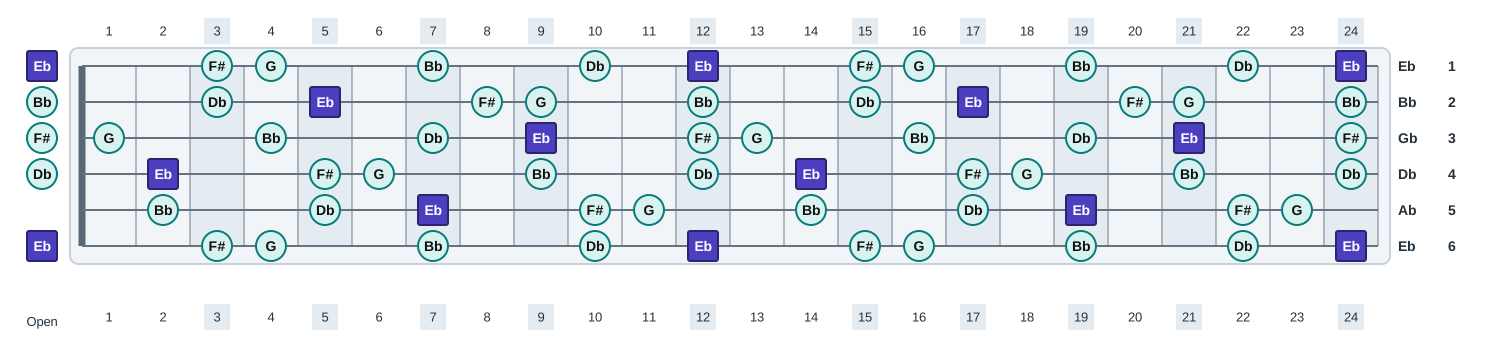
Open this diagram in the fretboard tool
Start with Eb Dominant 7 Sharp 9 Arpeggio and e flat standard tuningloaded, then adjust labels, colors, fret count, and orientation.
Open in interactive fretboard