Tuning-specific arpeggio diagram
F Minor Arpeggio in 8-String Standard Tuning
F Minor Arpeggio in 8-String Standard Tuning shows the same f minor arpeggio chord tones across 8 strings tuned F# B E A D G B E. The seventh and eighth strings extend the arpeggio into the lower register for wider-range chord tones and riff shapes.
- Chord tones
- F, Ab, C
- Formula
- 1 b3 5
- Semitones
- 0 3 7
- Chord symbols
- Fm, Fmin
- Tuning
- F# B E A D G B E
- Strings
- 8
- Open pitch range
- F#1 to E4
- 24-fret range
- F#1 to E6
Open strings and root positions
None of the 8 open strings belongs to F Minor Arpeggio. Every arpeggio tone must therefore be fretted, beginning with the first available tone on the low F# string.
First root on each string
String 8Fret 11
String 7Fret 6
String 6Fret 1
String 5Fret 8
String 4Fret 3
String 3Fret 10
String 2Fret 6
String 1Fret 1
Low-string pattern
On the lowest F# string, the first-octave arpeggio pattern falls at frets 2, 6, and 11, with the F root at fret 11. On the highest E string, the first F is at fret 1.
Fret 2Abb3
Fret 6C5
Fret 11F1
Practice this tuning-specific layout
- Play F Minor Arpeggio on the low F# string at frets 2, 6, and 11, saying each note name and degree aloud.
- Play the arpeggio without using an open string, then stop on the nearest F root each time the line changes strings.
- Connect the F root positions on strings 8 through 1 at frets 11, 6, 1, 8, 3, 10, 6, and 1, adding the nearest arpeggio tone between each pair of roots.
Fretboard diagram
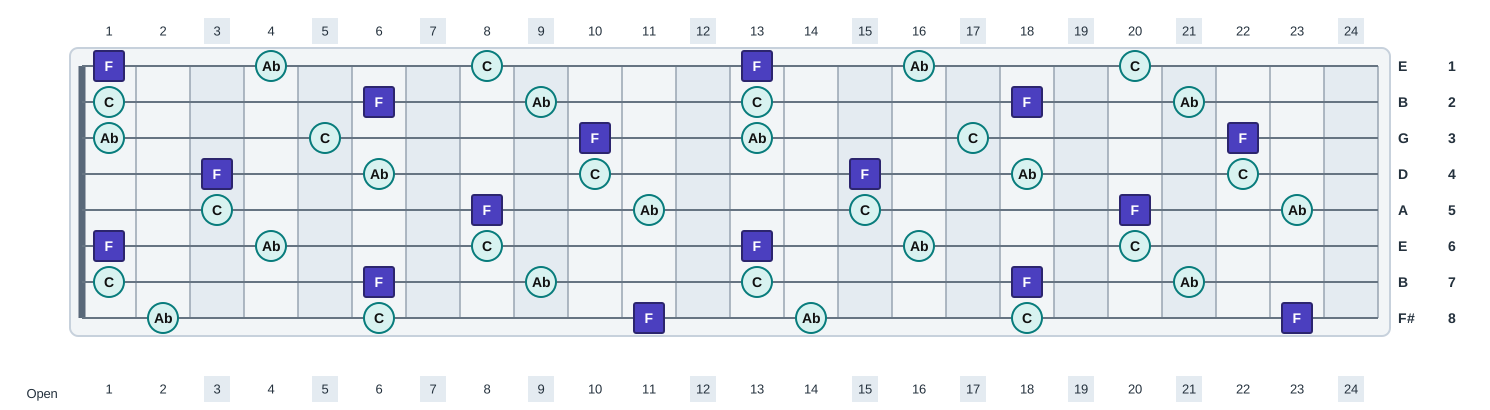
Open this diagram in the fretboard tool
Start with F Minor Arpeggio and 8-string standard tuningloaded, then adjust labels, colors, fret count, and orientation.
Open in interactive fretboardReference pages
Related diagrams in this tuning
Related scale diagrams in this tuning
Same arpeggio in other tunings
E Flat Standard TuningEb Ab Db Gb Bb EbD Standard TuningD G C F A DC Standard TuningC F Bb Eb G CB Standard TuningB E A D F# BDrop D TuningD A D G B EDrop C# TuningC# G# C# F# A# D#Drop C TuningC G C F A DDrop B TuningB F# B E G# C#DADGAD TuningD A D G A DOpen E TuningE B E G# B EOpen D TuningD A D F# A DOpen G TuningD G D G B DOpen C TuningC G C G C EOpen A TuningE A E A C# E7-String Standard TuningB E A D G B E7-String Drop A TuningA E A D G B E7-String Drop G TuningG D G C F A D8-String Drop E TuningE B E A D G B E