Tuning-specific scale diagram
C Major (Ionian) Scale in Open A Tuning
C Major (Ionian) Scale in Open A Tuning shows the same c major (ionian) scale pitch classes across 6 strings tuned E A E A C# E. The tuning changes where the same pitch classes sit across the fretboard.
- Scale notes
- C, D, E, F, G, A, B
- Formula
- 1 2 3 4 5 6 7
- Semitones
- 0 2 4 5 7 9 11
- Parent scale
- C major
- Tuning
- E A E A C# E
- Strings
- 6
- Open pitch range
- E2 to E4
- 24-fret range
- E2 to E6
Open strings and root positions
5 of the 6 open strings belong to C Major (Ionian) Scale: string 6 E (3), string 5 A (6), string 4 E (3), string 3 A (6), and string 1 E (3). None of those open-string tones is the C root, so the root must be fretted on every string.
First root on each string
Low-string pattern
On the lowest E string, the first-octave scale pattern falls at frets 0, 1, 3, 5, 7, 8, and 10, with the C root at fret 8. On the highest E string, the first C is at fret 8.
Practice this tuning-specific layout
- Play C Major (Ionian) Scale on the low E string at frets 0, 1, 3, 5, 7, 8, and 10, saying each note name and degree aloud.
- Build a phrase that lets E on open string 6 ring, then connect it to the nearest C root and two other scale tones.
- Connect the C root positions on strings 6 through 1 at frets 8, 3, 8, 3, 11, and 8, adding the nearest scale tone between each pair of roots.
Fretboard diagram
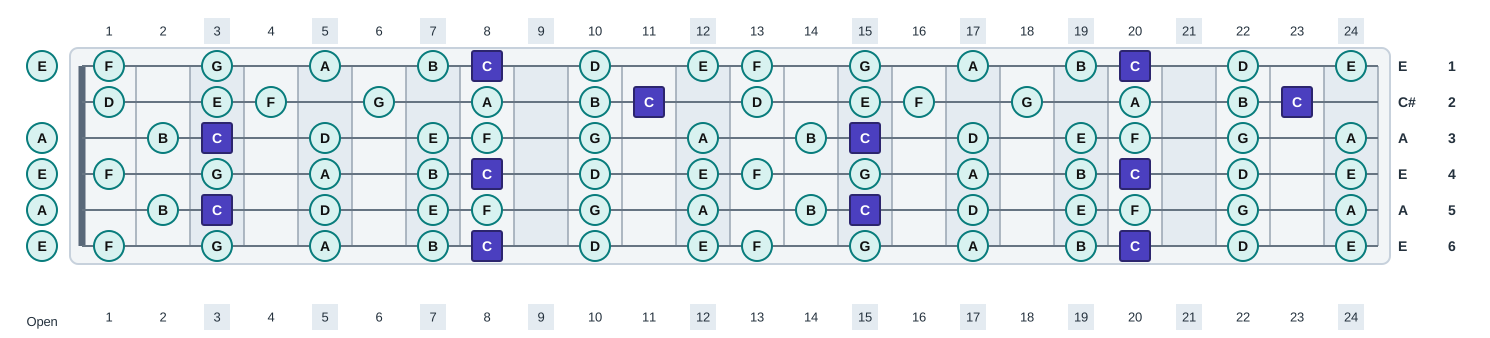
Open this diagram in the fretboard tool
Start with C Major (Ionian) Scale and open a tuningloaded, then adjust labels, colors, fret count, and orientation.
Open in interactive fretboard