Guitar scale
F# Phrygian Guitar Scale
F# Phrygian is a seven-note scale built from F#, G, A, B, C#, D, and E. It is the 3rd relative mode of D major. Use it to study the scale's notes, interval formula, and guitar fretboard positions.
- Notes
- F#, G, A, B, C#, D, E
- Formula
- 1 b2 b3 4 5 b6 b7
- Semitones
- 0 1 3 5 7 8 10
- Parent scale
- D major
How to read this scale
The notes are shown as pitch classes first. Square markers representF# root notes in the fretboard view, while circular markers represent the other notes in the scale.
Use the interactive fretboard to locate the F# root notes and connect the remaining phrygian tones across standard tuning.
Sound and defining tones
F# Phrygian is defined by the close pull between the root and b2 (G) and b3 (A). The flat second creates immediate tension, while the flat third confirms the minor quality.
- Characteristic tones
- b2Gb3A
Fretboard diagram
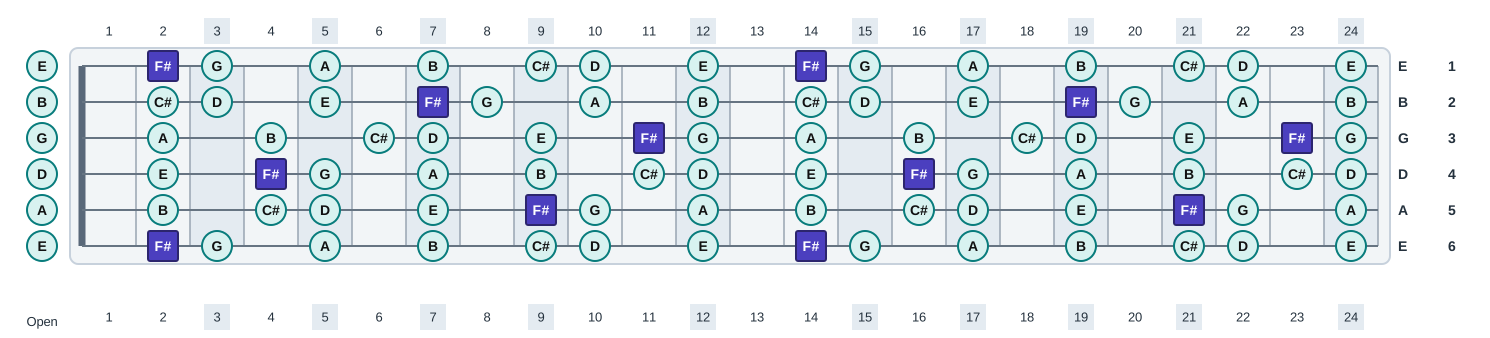
Open this scale in the fretboard tool
Start with F# Phrygian loaded, then adjust tuning, labels, colors, fret count, and orientation.
Open in interactive fretboardCommon chords and contexts
Use F# Phrygian over a minor pedal or riff centered on F# when the flat second is present in the harmony. Avoid forcing it over ordinary natural-minor progressions whose second degree is natural.
- Use F# Phrygian over dark F# minor vamps when the flat 2 is part of the sound.
- It fits heavier rock, metal, Spanish-flavored ideas, and modal minor progressions.
Practice this scale on guitar
- Play F# Phrygian from one F# root to the next in at least two fretboard positions, saying each note name and scale degree aloud.
- Repeat a one-fret root-to-flat-second figure around several F# positions, then connect it to b2 (G) and b3 (A).
- Create a short F# pedal-tone riff and answer it with phrases that feature the flat second before resolving to the root.